
Historic Personalities
Lieutenant James Bradley
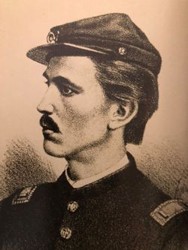 Was born in Ohio, and joined the U. S. Army at the age of 17. Captured during the Civil War, he was imprisoned at the notorious Andersonville Confederate prisoner camp.
Near the end of his military career, he was stationed at Fort Shaw, Montana serving under General John Gibbon. His career ended tragically under Gibbon’s command when he was fatally wounded at the Battle of the Big Hole.
While in Montana, his scholarly insights turned into a passion for the history of the region. In addition to interviews with settlers, natives, and trappers he became fascinated with the geography and history of the area.
Among his most valuable contributions were the copious, detailed records he compiled detailing his experience and his travels.
During his time at Fort Shaw Bradley served as Gibbon’s Chief of Scouts, utilizing his skills for providing detailed, comprehensive intelligence to the command. He was in charge of the scouting force during the Montana Column’s march parallel to Custer’s foray toward the Little Big Horn.
Bradley was a highly disciplined, experienced soldier-scholar who highly valued methodical reconnaissance, heavily relying on his Crow scouts to track Indian movements.
In contrast, Custer was widely known for his flamboyant, aggressive, and sometimes reckless style of warfare.
The grand strategy designed by Department Commander General Alfred Terry was for Custer’s cavalry to push the native forces down the valley of the Little Big Horn while Colonel John Gibbon’s Montana Column (including Bradley) blocked their escape from the north.
Custer famously struck prematurely on June 25.
Through his daily entries, Bradley had subtly conveyed anxiety regarding Custer’s predictability- or lack thereof- noting that Custer historically relied heavily on “Custer’s luck” and impulsive offense over careful intelligence.
On June 27, 1876, Bradley and his scouts were the first to discover the bodies of Custer and the five cavalry companies that had been wiped out.
After Bradley discovered the horrific reality on the battlefield on June 27, his tone transformed from professional skeptic to protective chronicler.
When a media storm and a military blame-game erupted back East—with many officers instantly trying to scapegoat Custer for disobeying orders—Bradley’s records provided a grounding, objective perspective.
A copy of a letter he submitted to the Helena Herald on July 25, 1876 is included at the end of this post.
Bradley was killed in action at the age of 33 during a surprise charge by Nez Perce fighters at the Battle of the Big Hole on August 9, 1877, fighting Chief Joseph’s forces.
Following his death, his widow donated his comprehensive notes and journals to the Montana Historical Society.
His notes were also the basis for “The Montana Column: March to the Little Bighorn”, available through the gift shop at the Fort Shaw National Historic Site.
Doctor Rose Russell
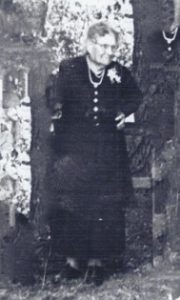 Doctor Rose Russell was born on May 17, 1866, the same year Fort Shaw was conceived.
She was one of the few women to receive her medical degree. She graduated from Northwestern University Women’s Medical College in Chicago, Ill, in 1900. She was licensed to practice in Illinois, Wisconsin and Iowa before coming to Montana.
She bought a buggy and a horse named King that became her trademark. She never owned an automobile, being transported to patients by other people’s automobiles when necessary.
She made house calls in all kinds of weather. On one occasion she delivered a young lady of triplets. It is said that it was so cold that as each was born they placed it in a wooden box and set it on an open oven door to keep it warm. She later made the mother a log-cabin quilt that is among several of her possessions on display at the Fort Shaw national Historic Site. She charged fifty cents for a house call, but most of the time traded produce for pay.
She had the quality of being a keen diagnostician and on a number of occasions doctors from the Great Falls hospitals called upon her to consult on cases.
She formulated her own medications. In her day pre-filled capsules were not common. Medical suppliers would express needed supplies to her, and she would have to fill empty capsules with carefully measured doses of drugs to treat various illnesses.
She bought an 80 acre homestead that had never been proved up by its previous owner. It had no house on it, so she hired craftsmen to builder her one with a special room to allow her to use with her patients.
Later she bought an additional 40 acres.
She worked the farm just like any other homesteader. Each year she raised a flock of turkeys to supplement her income.
She later communicated by telephone, the lines for the new-fangled device being stretched along the fence posts. Attention from animals kept its maintenance interesting.
Age took its toll, and in 1947 she leased the farm and moved into a small home in Fort Shaw. She continued a limited practice for another nine years.
In September, 1956 she entered Columbus hospital, where she passed at the age of 90 years on Sept. 28.

The Sun River Valley Historical Society is a 501-c-3 non-profit organization and all gifts are tax deductible. Thank you for your support.
SUN RIVER VALLEY HISTORICAL SOCIETY
P. O. Box 155
Sun River, MT 59483
sunrivervalleyhistsociety@gmail.com
