
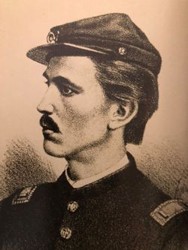
 Was born in Ohio, and joined the U. S. Army at the age of 17. Captured during the Civil War, he was imprisoned at the notorious Andersonville Confederate prisoner camp.
Near the end of his military career, he was stationed at Fort Shaw, Montana serving under General John Gibbon. His career ended tragically under Gibbon’s command when he was fatally wounded at the Battle of the Big Hole.
While in Montana, his scholarly insights turned into a passion for the history of the region. In addition to interviews with settlers, natives, and trappers he became fascinated with the geography and history of the area.
Among his most valuable contributions were the copious, detailed records he compiled detailing his experience and his travels.
During his time at Fort Shaw Bradley served as Gibbon’s Chief of Scouts, utilizing his skills for providing detailed, comprehensive intelligence to the command. He was in charge of the scouting force during the Montana Column’s march parallel to Custer’s foray toward the Little Big Horn.
Bradley was a highly disciplined, experienced soldier-scholar who highly valued methodical reconnaissance, heavily relying on his Crow scouts to track Indian movements.
In contrast, Custer was widely known for his flamboyant, aggressive, and sometimes reckless style of warfare.
The grand strategy designed by Department Commander General Alfred Terry was for Custer’s cavalry to push the native forces down the valley of the Little Big Horn while Colonel John Gibbon’s Montana Column (including Bradley) blocked their escape from the north.
Custer famously struck prematurely on June 25.
Through his daily entries, Bradley had subtly conveyed anxiety regarding Custer’s predictability- or lack thereof- noting that Custer historically relied heavily on “Custer’s luck” and impulsive offense over careful intelligence.
On June 27, 1876, Bradley and his scouts were the first to discover the bodies of Custer and the five cavalry companies that had been wiped out.
After Bradley discovered the horrific reality on the battlefield on June 27, his tone transformed from professional skeptic to protective chronicler.
When a media storm and a military blame-game erupted back East—with many officers instantly trying to scapegoat Custer for disobeying orders—Bradley’s records provided a grounding, objective perspective.
A copy of a letter he submitted to the Helena Herald on July 25, 1876 is included at the end of this post.
Bradley was killed in action at the age of 33 during a surprise charge by Nez Perce fighters at the Battle of the Big Hole on August 9, 1877, fighting Chief Joseph’s forces.
Following his death, his widow donated his comprehensive notes and journals to the Montana Historical Society.
His notes were also the basis for “The Montana Column: March to the Little Bighorn”, available through the gift shop at the Fort Shaw National Historic Site.