
Remembering the Fort Shaw Indian School Girls: The Birth of Girls’ Basketball in Montana (continued)
By Ken Robison
Most spectators in Montana never had attended a basketball game. A Great Falls Leader sports writer described the action in Luther’s Hall in the first basketball game ever played in the Electric City:
“Talk about excitement! Two wrestling matches, a football slaughter, three ping-pong tournaments, a ladies’ whist contest, a pink tea, and one Schubert musical recital combined, would fall short in comparison with one game of basket-ball as it is played. It was the first game ever seen in Great Falls, but there will be others. Five hundred and forty people paid cash at the box office for admission last night, besides those who had purchased tickets previously, so that in all there were over seven hundred people present, and the hall was packed like a sardine box, over 300 people standing about the end and sides of the wall. It was a success from a box office standpoint, and the shouting and enthusiasm would indicate that it also was a success from the audience point of view.
“Basket-ball is a game where you can be comfortable, carry the colors of your team, yell as loud and as long as you desire, wear your best bib and tucker, and witness a howling football match with the slaughter house elements cut out, while at the same time keeping your clothes and conscience as clean as the driven snow. The game is easy. To see it is to understand all about it, and this makes it a game above all others for the ladies. At each end of the hall there are hung about ten feet above the floor, what are termed baskets, but which are really dip nets, with an iron ring eighteen inches in diameter forming the top. The idea of each team is to get the round fat ten-inch football into their dip net, and when they do so it counts two–sometimes it counts one–but the referee obliging stops and tell what is, so there is no darkness upon this point.
“Between the baskets, or dip nets, there are a number of pretty figures traced upon the floor with chalk which forms the court, the outer boundaries being the first row of very excited spectators. The players are not supposed to play outside of the boundaries. Five girls on each side constitute a team, and two twenty-minute halves constitute the game. Last night there were three twelve-minute thirds, but that was entirely unaccording to Hoyle. The referee throws the ball up and then there is a mix, which makes the audience howl. A little bloomer girl shoots out of the pile and another little bloomer girl with short skirt over the bloomer part, hops on the first little girl, and the referee blows the whistle and separates the bunch. Then it all begins over again and half a dozen little girls slide head-first into the crowd after the fat ball and upset a few spectators in the slide. The referee blows his whistle and a very red-faced little bloomer lady with very much rumpled hair and both arms clasped tightly over the fat ball, emerges in triumph from the midst of chaos, and the crowd yells in ecstasy.
“More sliding, running, tumbling and mix-up; a little girl fires the fat ball for her fishnet and as it misses dropping in, the crowd groans ‘A-a-a-ah!’ in a tone which would indicate that the fishnet has been guilty of a personal affront. There are more mix-ups and half a dozen little girls manage to smash a chair, upset a fat man, break an electric light globe, and in the midst of it all a very excited little lady throws the fat ball toward the ceiling and it returns to fall safe in her fishnet, while the crowd yells like rooters, at Yale-Harvard finish. There is a rest between times and at the end the umpire announces the result and the audience comes out of a trance and declares the game to be the best ever.
. . .“For real fun and a chance to howl naturally, without appearing a rude, untamed person from Greater New York, basket-ball is the unadulterated essence of the proper thing and its initial appearance in Great Falls created a furor.”
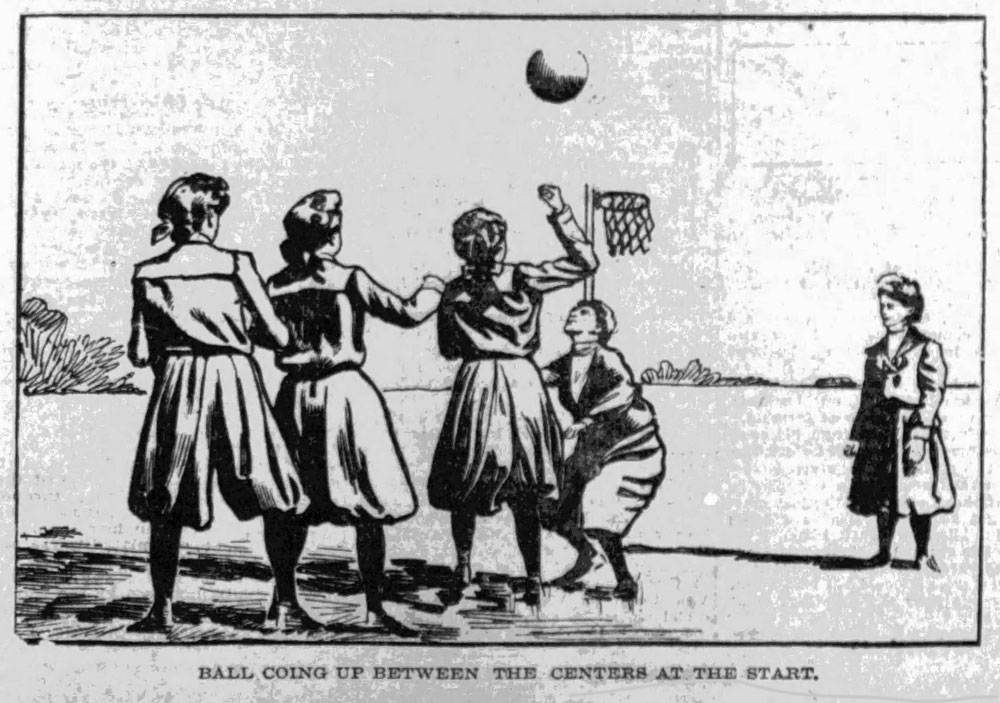
Photo: Sketch of Girl’s Basketball: “Ball Going Up Between The Centers at the Start. Butte Miner, May 1, 1902.
Over a two-year period during 1902-03, Fort Shaw Superintendent Campbell assembled a traveling entertainment program far beyond simply the game of basketball. Drawing crowds of up to a thousand spectators, the Fort Shaw “show” typically consisted of music by a mandolin orchestra, demonstrations of Indian club swinging, literary recitations by scholars, followed by the main attraction, the basketball game. After the game, the home school often hosted a banquet or reception and dance for the Fort Shaw girls, completing the evening’s entertainment.
The Fort Shaw traveling road show drew huge crowds and rave notices in the press wherever they went. Campbell scheduled three types of contests for the girls. Against organized high school teams, Fort Shaw played a serious, conventional game of basketball—boys’ rules full court, not girls’ half-court. If the opponent had just organized a team, the Fort Shaw girls would provide a handicap, playing four of their girls against five or six opponents. If the host town had no team, the Fort Shaw girls would split their squad into two teams, giving an entertaining exhibition game of basketball.
In June 1903, the Fort Shaw Girls kicked off a barnstorming tour across the Hi-Line to raise funds for a planned trip to the St. Louis World’s Fair the following year. A game was played in Great Falls, won by the Fort Shaw Girls by a score of 45-1, despite a handicap playing four Fort Shaw girls to six Great Falls girls. The Leader headlined the debacle: “Was Absolutely Nothing To It. Four Little Indians Play Rings Around Six Home Girls. Just Like Shooting Fish. Nettie Wirth Makes Most Sensational Play Ever Recorded in Hall.” The Leader went on to report: “The sensational play of the evening, and the greatest ever seen in the hall was made by Nettie Wirth on a throw up of the ball, she reaching up and striking it square into the basket from the umpire’s hands, while her opponent gasped in astonishment.”
The next morning, Tuesday June 9th, the Fort Shaw traveling show consisting of orchestra, club swingers, scholars, basketball players, and chaperons, Superintendent Campbell, W. J. Peters and Miss Sadie F. Malley, boarded the Great Northern train to barnstorm through six towns in Northern Montana in six days. Two Fort Shaw basketball teams, called the “blues” and the “browns,” played a demanding series of exhibition games as follows:
June 9, Fort Benton.
June 10, Havre.
June 11, Chinook.
June 12, Harlem.
June 13 Glasgow.
June 14, Fort Peck, located at Poplar Agency.
Tuesday evening Green’s Opera House in Fort Benton was the scene for the first exhibition game—today, that is the second floor of the Benton Pharmacy and the only known remaining venue for the Fort Shaw Girls’ games.
The Fort Benton River Press reported, “The entertainment given last night at Green’s hall, which consisted of club swinging and basket ball by the Indian girls of the Fort Shaw Indian Industrial school, was a grand success, socially and financially. While both teams, the ‘blues’ and ‘browns’ acquitted themselves admirably in the games played by them, it was noticeable that the Misses Emma Sansaver, formerly a resident of Fort Benton, and Belle Johnson, a former resident of Highwood, were the favorites of the audience.”
Emma Sansaver, with a Métis father and Chippewa-Cree mother and the smallest member of the team, was born near Fort Assiniboine. Her mother, Mary LaFromboise Sansaver, was murdered about 1898 near Havre. Despite a concerted investigation by Chouteau County Attorney Charles N. Pray, no one was ever convicted for Mary’s murder. Belle Johnson was the daughter of Swedish immigrant miner, Charles Johnson, while her mother, Nearly Dead, was Piikani Blackfeet. Belle was born and raised near Belt and attended the Holy Family Mission school on the Blackfeet reservation. Both Emma and Belle were exceptional athletes and basketball players.
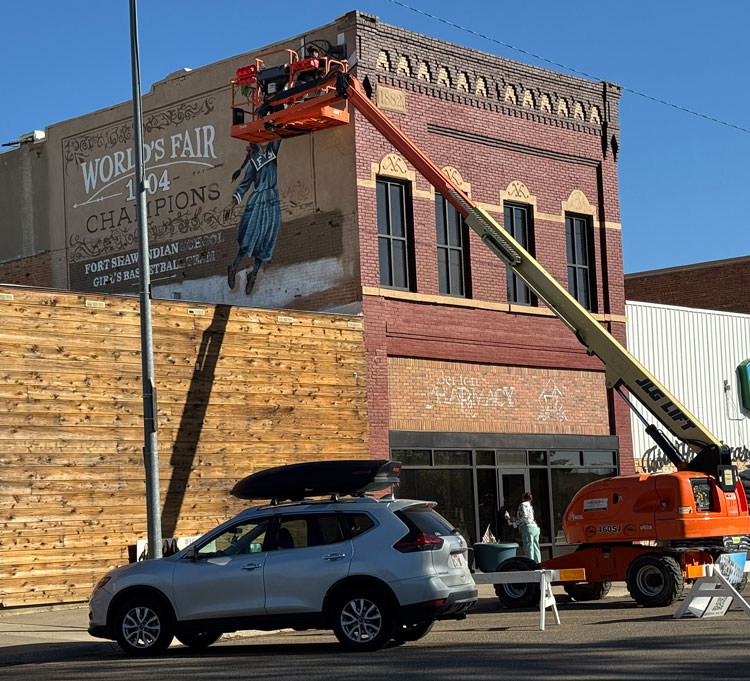
Photo credit- Ken Robison: Fort Shaw Girls’ Tribute Mural being painted on the side of Green’s Opera House on the second floor of today’s Benton Pharmacy.
The next day, the traveling show moved on to Havre. In the words of the Havre Plaindealer, “In every way a creditable entertainment was that given by the Fort Shaw Indian girls basket ball team at Swanton’s hall, Wednesday night. A match game between two teams was played before a large audience, many of whom had never seen a basket ball game, and but few had ever seen the Indian girls exemplify the sport. The Fort Shaw team enjoys the distinction of being the state champions, having defeated all the teams of the state. Briefly stated, the girls play a clever, fast and snappy game. The entertainment was fully enjoyed and was concluded by a dance following the game. Superintendent F. C. Campbell spoke briefly of the benefits of Indian education and of the progress made with the Indians who have come under Uncle Sam’s educational wing in this section of the state.”
Moving on to Chinook on Thursday evening, the Fort Shaw girls “gave an excellent exhibition of the game at the town hall . . . a very good and appreciative audience filled the hall.” After the exhibition was over the hosts held a social dance that continued until the early hours of Friday.
Another day, another stop along the Hi-Line, this time at Harlem, where the Harlem Hearsay reporter in the Chinook Opinion reported, “The people of Harlem and vicinity were given a very pleasant and enjoyable time on Friday evening of last week, when the Fort Shaw Indian girls gave an entertainment consisting of a basket ball game and an exhibition of Indian club swinging. The game was a very good exhibition of team work and heady individual playing. In the first half the teamwork was somewhat broken on account of a substitute having to take the place of one of the regular players on the first team. The score at the end of the first half was 8 to 6 in favor of the first team. In the second half the substitute was taken off the first team and the remaining four regular players played the five on the second team. This was a big handicap, as it left one member of the second team free to play without any guard for interference, but the four played so much better team work, that the score at the end of the game was 25 to 10 in favor of the first team . . . . After the game several stayed to enjoy a social dance.”

Photo: Going to St. Louis World’s Fair: Everybody Is Going. Great Falls Leader, May 4, 1904.
On Saturday at Glasgow, the game proved so popular that the teams were asked to play again, so the girls played a second game on their return trip. The Glasgow Montana Citizen reported: “The Fort Shaw Indian girls gave an exhibition of basket ball at the court house last Saturday evening and played to a crowded house. . . After the game which stood about 30 to 40 in favor of the blues, who at present hold the championship of the state, a dance was indulged in. The music furnished by the Fort Shaw string band was excellent and the young gentlemen of Glasgow rather enjoyed dancing with the lady like attractive sun-kissed maidens of the plains. A return engagement was played Wednesday evening and resulted in a victory for the grey’s by a score of 20 to 21”.
At Poplar, the agency for the Fort Peck reservation, two games were played with admission charged at the first, while the second performance was free of charge to Indian children and the elderly.
The next year, about two months before they left for St. Louis, the Fort Shaw Team returned to Green’s Opera House for another game in Fort Benton the night of March 29. The River Press reported: “The Indian Basketball Team. There was a good attendance at the entertainment given by pupils of the Fort Shaw Indian school Tuesday evening, and the audience was well pleased with the program that was rendered. The members of the company had evidently been carefully trained and drilled, and the result was most creditable to themselves and their instructor
“The star artist of the company is Louis Youpee, a quaint little 8-year old boy, who delivered several recitations of a humorous nature and who was repeatedly encored. John Minesinger in his character sketches was remarkably good, and the excellent violin work by Miss Evans was an attractive musical feature of the entertainment. The concert recitation of ‘The Famine’ from Hiawatha by nine girls in handsome Indian costumes was most effectively rendered, and was received with hearty applause.
“After an exhibition of bar bell exercises and Indian club swinging the entertainment was concluded with a basketball game between a ‘red’ team of five and a ‘blue’ team of four, in which the players showed surprising quickness and ability. It was a fast and furious contest, and at its close the reds were the winners by a score of 14 to 13. The teams will go to the St. louis exposition, where Superintendent Campbell proposes to enter them for the basketball championship and other competitive events for which they are eligible.”
The girls of Fort Shaw continued to play an exceptional brand of basketball. These remarkable young ladies were ambassadors for Montana girls’ basketball as well as for Indian education and trailblazers for their broad and popular acceptance as social and athletic equals. Just imagine what their young ladies must have felt as they departed for St. Louis—in the words of the Leader: “The girls will probably remain in St. Louis during the summer and the assignment is looked upon by them as the height of human possible bliss.”
In June 1904, “Montana’s team” barnstormed their way from Montana to St. Louis, Missouri. There at the St. Louis World’s Fair, the Fort Shaw Indian School Girls’ Basketball team gained immortality when they defeated all comers to be crowned in glory “the 1904 World Champions.”
Special Note: Most students at Fort Shaw Indian Industrial School, and all members of the Girls’ Basketball Team, were biracial with White or biracial fathers. These were children already in the complex zone between two worlds, White and Native societies, and potentially clashing cultures. At the very time the Fort Shaw girls were being cheered by thousands of fans, mostly non-Native, some boys at the school became runaways, and at times perished in their flight to “freedom” and return to home. Today many condemn governmental off-reservation boarding schools for “taking the Indian out of the person,” yet in the case of Fort Shaw most of its students were not “just Indian” or “just White,” but a blend of both. I might add also that Fort Shaw was blessed with a very enlightened and dedicated educator in Superintendent Fred C. Campbell.

The Sun River Valley Historical Society is a 501-c-3 non-profit organization and all gifts are tax deductible. Thank you for your support.
SUN RIVER VALLEY HISTORICAL SOCIETY
P. O. Box 155
Sun River, MT 59483
sunrivervalleyhistsociety@gmail.com
